8 Billion People on Earth: Demographic Issues

Today, November 15th 2022, the World is expected to have reached a human population of 8 billion people, according to a UN report. In our time on this Earth we have developed different cultures, languages, buildings, myths and shared a history together. The growth of population has been rather exponential when looking at past graphs, with the global population estimated to have been around 4 billion in 1974. This means that our total population, roughly, doubled in a timespan of less than 50 years. This does not mean, however, that we are likely to hit 16 billion people in 2075. Nonetheless, there have been concerns about overpopulation since at least 1798, when Thomas Malthus wrote “The power of population is indefinitely greater than the power in the earth to produce subsistence for man”. Should we really be worried about total population? Or is relative population distribution between age groups more threatening in the short-run?

Photograph: TT News Agency/Reuters
Hans Rosling, in the photograph above, was one of the most influential speakers on population growth. His Ted Talks, filled with witty humour, made statistical analysis interesting and easy to absorb, often including visual representations. Dr. Rosling was a firm believer that the Earth’s population will not to exceed 11 billion people. According to his findings the birth rate has been consistently lowering and remains quite stable at around 2 children. This is approximately the “replacement rate”, or the rate at which populations replace one another without growing over time. In Rosling’s view, education and incorporation of women in the workforce, combined with the availability of contraceptives and lowered infant mortality has made the birth rate fall in several countries, lowering the global average.
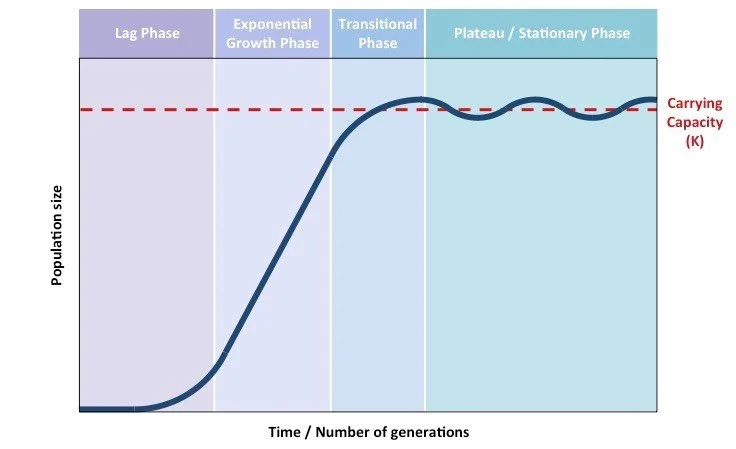
Source: Bioninja.com.au
In biology population growth of non-human species is often described using the S-curve shown above. The population in a new environment will start small and grow steadily, before reaching an exponential growth in the exponential growth phase seen above. Finally, as resources become limited and it becomes harder to sustain more people, population levels off around the carrying capacity (k). Hans Rosling proposes a similar theory for humans. We might have just undergone the exponential growth. Now, with the increased number of people, inflation, water scarcity and economic instability, we might find ourselves tailing off around the carrying capacity. This number can also increase, as new technology will allow us to extract and use resources more efficiently.
If we look at some of the biggest demographic issues around the globe, we find that large disparities between age groups can cause economic, social and political issues. Perhaps it is the inter-generational disparity that should merit more attention.

Since we had an exponential growth in population, followed by a declining birth rate in several countries, demographic ageing is a real problem across the globe. Japan is one of the most notorious examples around the globe, with almost 30% of their population being above 65 years old. However, many countries are following the same course. In China the one child policy was reversed in 2016 increasing the number to two children. The reversal showing little effect has prompted a further increase to three children. The largest fear is that the younger generations will not be able to produce enough economic output to support the pensions and benefits of the seniors. On the other hand, the large group of seniors have benefitted a lot from their cohort size. Having a large cohort that is likely to share views on age-related policy, gave boomers a political advantage at the ballot box for decades. Things are slowly changing, with Millennials approaching the same size for U.S. voters.

The most obvious solution to the short-term issue of demographic gaps, is to seal the proverbial holes with immigration from countries with surplus youth. Some countries around the world are implementing this strategy, Singapore is trying to attract top-foreign talent to boost its economy. Many more countries could soon be holding up a welcome sign to economically motivated immigrants, as their work could be needed to support the ageing populations of many developed economies. Hopefully we can sort out our differences and prosper at a global level.